


Today marks 83 years since President Roosevelt signed Executive Order 9066, the racially–targeted order that led to the forced removal of 120,000 Japanese Americans and unlawfully incarcerated them in prison camps across the West Coast.
Farmers, merchants, and families who were part of the heart and soul of early Pike Place Market were unjustly forced to abandon their jobs, their homes, and their lives. Not a single Issei (“first generation”, emigrants from Japan) or Nisei (“second generation”, U.S. citizens) were ever charged or convicted of espionage, yet thousands of families suffered the cost of our country’s racial exclusion and paranoia.
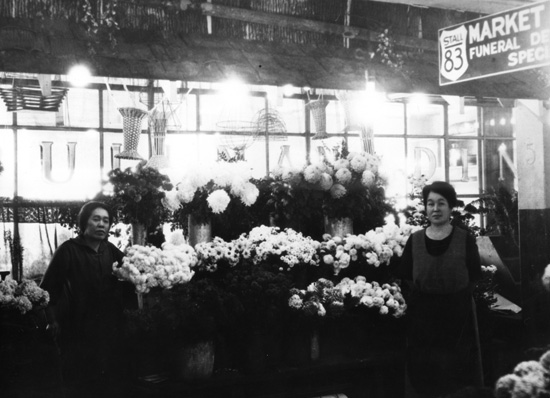
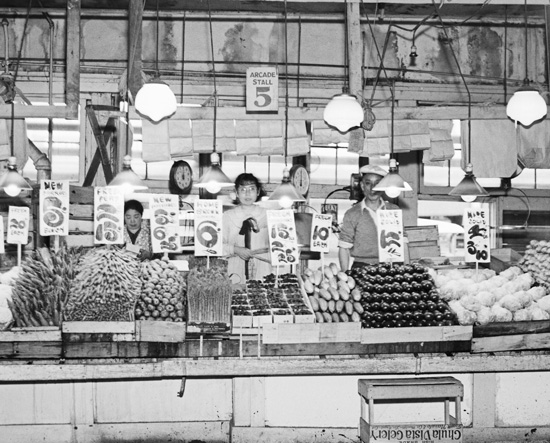
This order was the culmination of five decades of xenophobia experienced by the Nikkei (“of Japanese lineage”, people of the Japanese diaspora) as they sought to establish their livelihoods in Seattle and at the Market. Issei farmers were among the first to sell produce on Pike Place Market’s opening day in 1907, contributing to the district’s growth into a thriving destination.
They experienced discriminatory practices in daily stall assignments, as stalls were designated by race and gave preferential spots to white farmers, even though farmers of Japanese ancestry outnumbered them two to one. The Japanese community petitioned Seattle City Council four different times in the 1910s to change these practices, and were ignored. Despite racist policies continuing into the 1920s and 1930s, these farmers were the driving success of Pike Place Market, producing 75% of the fruits and vegetables sold.
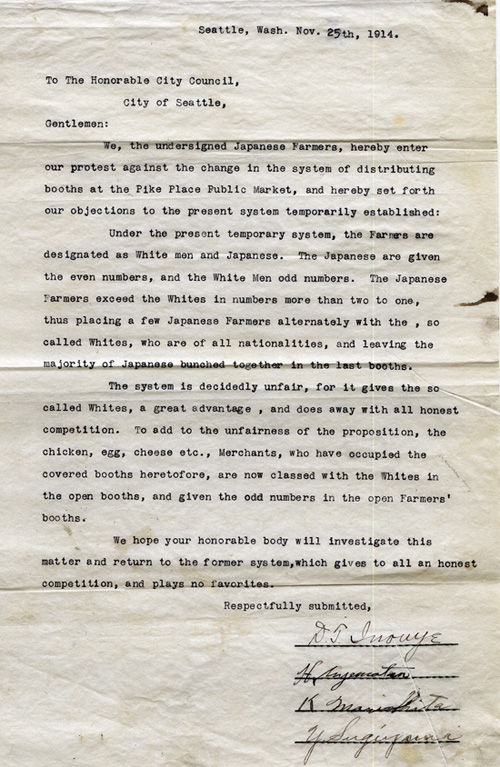 Japanese Farmers’ protest of racist booth distribution methods, 1914.
In the spring of 1942 after the executive order was issued, Market families with Japanese ancestry were abruptly arrested, detained without explanation, and imprisoned until the end of the war. Farmers were forced to give up their land and livelihoods, they were expelled from the city, and never returned to sell at Pike Place.
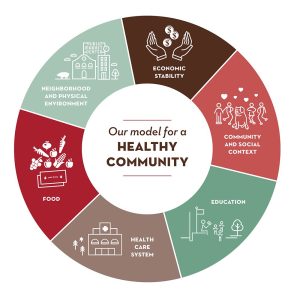
The Japanese community also played a vital role in promoting food access, childcare, and other elements of a healthy community model that the Market Foundation upholds today. Executive Order 9066 shattered this support system, leaving an irreplaceable gap in the Market.
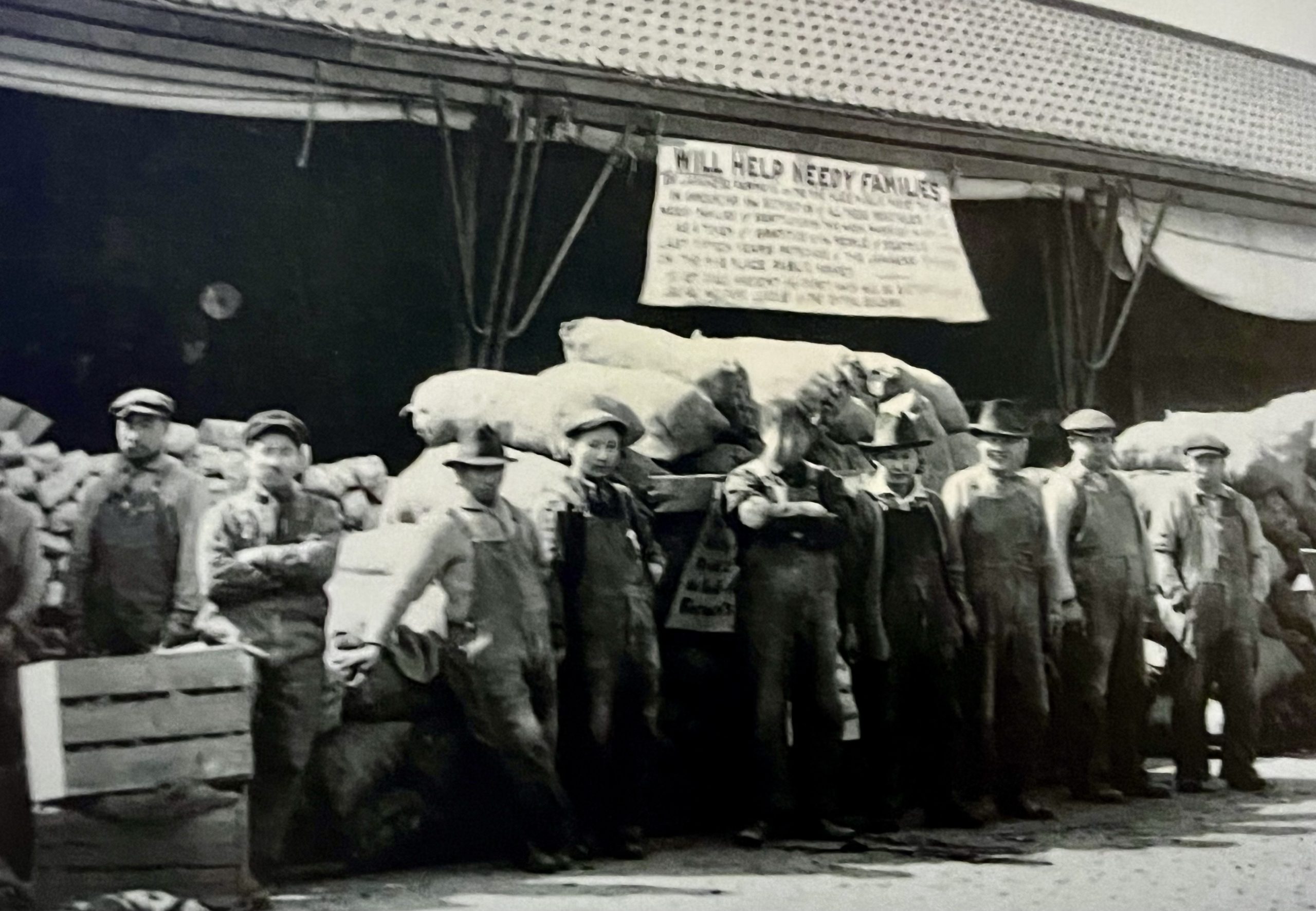 Issei (first generation) farmers at Pike Place Market. Their signs read “Will Help Needy Families”, and “These vegetables are given for FREE to the neighborhood from the Japanese farmers at Pike Place Market”.
On this Day of Remembrance, the Market Foundation acknowledges the irreversible harm and generational impact that Japanese-American incarceration had on the Market community. The exclusion of members of our community contradicts the very principles of the Market Foundation that Nikkei (of Japanese lineage) farmers and merchants helped instill in our neighborhood.
Today, the Market Foundation’s model for a healthy community strives to reduce barriers so that everyone in our neighborhood can live their best lives. Since our founding in 1982, the commitment is, and always has been, to keep our community members safe and supported by providing vital resources to improve health and wellbeing of everyone in our community.
In the spirit of the Japanese farmers who shared their produce, social service partners continue to ensure culturally appropriate food is accessible to all, regardless of income. The Foundation supports Market farmers facing systemic barriers through programs like The Farm Fund and the Bulk Buy Program. Learn more about the Market’s history of food access and the Foundation’s ongoing work on our website.
Pike Place Market’s 117-year history is built on the collective legacies of multiple generations of farmers, merchants, and families of diverse backgrounds, making this place the Soul of Seattle. The Market Foundation is committed to working with the community and sharing the stories of those who shaped this neighborhood and its rich traditions.
Do you or someone you know have family history at Pike Place Market? We want to hear your story:

Learn More:
- Read Seattle Times reporter Elise Takahama’s column about her great-grandfather getting arrested at his produce stand in Pike Place Market, and her family’s subsequent journey to understand the devastating effects of incarceration.
- Read Strawberry Days: How internment destroyed a Japanese American Community the history of the racist schemes that prevented the immigrants from reclaiming their land after the war.
- Explore Pike Place Market stories on Densho, a nonprofit founded in Seattle in 1996 that records oral testimonies of those incarcerated during WWII.
Events:
- Join Tsuru for Solidarity for Stop Repeating History: Day of Remembrance and Resistance on Feb. 19, 9:45 am at Hing Hay Park, 423 Maynard Ave S, Seattle, WA 98104
- Join events at Wing Luke Museum and attend one of Wing Luke Museum’s Japanese American Remembrance Trail Tours. an urban hike in Seattle’s original Japantown.

Photo credits:
- Photo of two farmers behind their produce stall pre-WWII: courtesy of the Pike Place PDA
- Photo of two women posing at their flower stall, 1939. Courtesy of Seattle Municipal Archives, Image 32317
- Protest of Japanese Farmers vs. method of distributing booths, 1914. Courtesy of Seattle Municipal Archives, Comptroller File 58632
- Photo of farmers distributing free produce courtesy of the PEMCO Webster & Stevens Collection (number 83.10.2125), Museum of History & Industry
- Photo with Japanese American farmers, 1936. Lights for G.G. stalls, item 90.2.1211, series 275, Seattle-King County Department of Public Health, box 7, King County Archives, Seattle, WA.
- Pike Place Market cherry blossom trees, courtesy of Pike Place Market PDA
- Photo of two farmers smiling in front of Market stall courtesy of Densho: The Japanese American Legacy Project. “Stall at the Public Market” (ddr-densho-34-123) Densho, Bainbridge Island Japanese American Community Collection.